
Farewelling Peter Bennett After 52 Years Working in Our Family Business
Thanks for 52 years!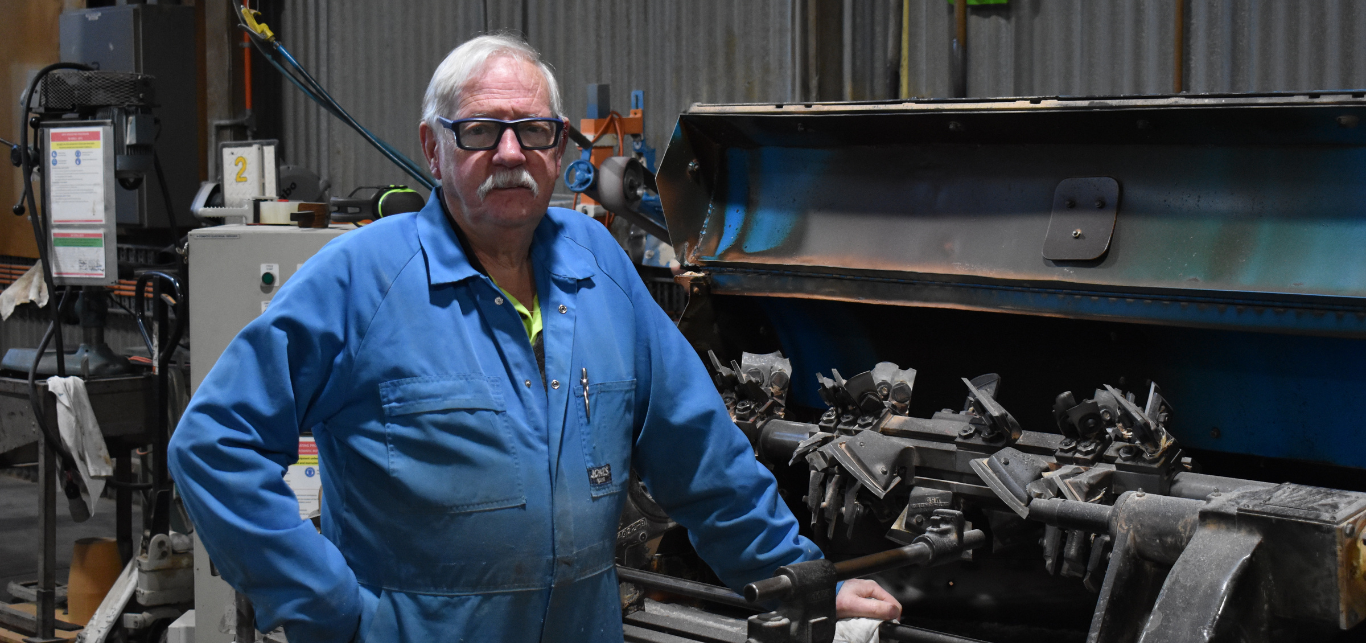
Farewelling Peter Bennett After 52 Years Working in Our Family Business
At the time of Peter's retirement, the national average time spent in a single job is 3.3 years and back in the 1970s this was 7-10 years. Peter Bennett has worked for Hammersmith for the past 52 years and with Peter's final day coming up, Wyatt Groth (3rd Generation Groth and Managing Director) took the time to sit down with Peter and discuss his time at Hammersmith.
You started with Hammersmith on the 14th of January 1974. How did you find out about the job, and who interviewed you?
I found out about the job in the Saturday Advertiser through an advertisement for an apprentice wood machinist. I was 16 years old, I had just finished year 11, and I was living in Gawler with my parents. I had studied woodwork in school, so it was something I was interested in.
After applying, I got an interview on a Saturday morning. The interview was conducted by Ted (the founder and owner) and his son Geoff, and at the end of the interview I was told that if I wanted the job, then I could start two days later on Monday.
What do you recall about your first day/week at work?
From memory, I was put on the Tyson machine, which was an automated rotary knife wood turning lathe that was at that point in time being exclusively used to make turned timber legs for TV sets that were being made at Philips in Adelaide.
Not only did I have to run the machine that turned the legs, but I also had to sand them as a secondary process. I loved the turning part, but hated the sanding.
So, you were employed as an apprentice?
Yes, I attended trade school down at Marleston and earned a trade as a wood machinist.
Many employees at Hammersmith have said that the founder, Ted Groth was a difficult person to work for. What was your experience like with him?
There was only one way to do a job, which was the “Ted way”. If you did this, then you had no issues. I generally got on well with him. In the early days I was not involved much with Ted. His specialty was working in the tool room and making sure the machines kept running if there were breakdowns, and also making specialty tooling parts to help speed up the process.
Do you recall how much your first full pay was?
I can remember it well. I was given a little envelope with $33.33 in it. $10 went to my parents for board and about $6 for private health insurance which my parents forced me to take out.
How many hours a week did you work on average in the early days?
A standard week was 40 hours. Started at 7am and worked through to 4pm. On Friday we knocked off a bit earlier. I didn’t work overtime during the week, as I had to catch public transport; but I would regularly work on a Saturday morning for about 4 hours.
You mentioned public transport. How long did the trip take, and how long did you do that for?
It took me a bit over an hour to get to work and about the same to get back home. I had to catch two trains, one from Gawler to the city and the other from the city to the Bowden train station, then walk about 10 minutes to get to work. I did this up until about 15 years ago, when I started driving the commute.
Did you ever consider leaving Hammersmith to work elsewhere?
Only once. It was in the early 1990’s; and Hammersmith were making timber components for a lighting manufacturer in Pooraka. They wanted to cut Hammersmith out of the loop to cut costs, and they had an old lathe, and were looking for someone to run it. They approached me and offered better money. I spoke to Geoff (who at this stage was the GM of the business), who was a bit upset with me about this, but we talked through it, and I got a pay increase and decided to stay at Hammersmith.
You said that your first job at Hammersmith was running the rotary knife lathe; but later on you were heavily involved in building the cutter heads that were run on these machines. How did this come about?
Up until the late 80’s, building a cutter head was a laborious task. All knives were hand ground, and it was a real skill to be able to do this. Kevin and Ted taught me a lot, and I slowly became more involved in this process.
The big change happened after Ted went to the USA in the late 80’s and saw how a company called Western Cutterheads were using computers to make the process more accurate. From what he learnt, he was able to adapt and improve this process so that we could use it to start making our own cutterheads in the same way. The end result was that cutterhead were far quicker to build, and with the benefit of computers, the quality of them was a massive improvement over the old hand ground ones that up until then we had been producing.
Now that we could produce cutter heads quicker, we actively started to pursue more wood turning jobs that were being done by other wood turning companies interstate; and as a result, for about the next 15 years I was working pretty much full time just building cutter heads that were being used by other staff in the factory to make products.
Being on the tooling side of things, I worked a lot more closely with Ted, and I think the respect that he had for me grew as a result.
What was your favourite machine?
The Mattison Matti-Max wood turning lathe. It was purchased from the USA in the early 90’s, and was the first wood turning lathe that we got that was controlled by a computer. We were therefore able to better control aspects of the turning process, which resulted in products being produced quicker and with better quality.
And your least favourite machine?
Any sander. I hated sanding.
What about timbers, what did you like and hate working with?
Coachwood was my favourite. It is not used anymore due to restrictions on logging, but it was a beautiful timber to turn. It was just hard enough that it produced a nice clean finish, but not too hard that it was abrasive on tooling.
My least favourite was Nyatoh (from Asia) and Tawa (from New Zealand). They were hard on tooling and produced a dust that made working with them not enjoyable.
25 years ago you went with Geoff to Italy. Why did you go, and what do you recall about the trip?
It was the first and only time that I have ever been overseas, so it was both exciting and nervous. We flew into London and visited Cheshire Mouldings to talk to them about building cutterheads for them. We then went to Italy to do training on how to run the software that was going to run the new 5-axis CNC that Geoff had just purchased.
This was in the late 1990’s, and unfortunately wood turning was on the decline, as changes in designs meant that wood turned products were not being used anywhere near as much as they had been over the past 30 years.
Hammersmith, and particularly Geoff was feeling the pressure of this, and a decision was made to shift the company away from being exclusively a wood turning business. Geoff had seen a 5-axis CNC machine about 6 months earlier, and decided (along with Ted) to buy it. The machine was Italian and (up until that point) was easily the most expensive piece of equipment that the company had ever purchased.
It was not a wood turning lathe, and it was controlled by computer software; both of which meant that it was totally a new way of us making timber products.
I had never operated a computer, but Geoff decided that if both of us went to Italy to learn, then we could both make it run.
My lack of computer knowledge compared to Geoff, meant that it was a very steep learning curve for me.
As a result, the trip we did overseas was nearly ALL work, and very little play. I did love the opportunity to go there, but I would have loved to have seen a bit more of Italy, other than mainly the inside of a training room.
The new machine arrived a couple of months after we got back, and Geoff and I started the long process of putting into practice what we had learned. Geoff was much better at it than I was, but I am pretty proud of myself that I was able to adapt and learn something new that was totally out of my comfort zone.
Buying this machine was a huge risk for the business, but if they had not done it, I don’t think the company would still be running today.
You have worked at Hammersmith for over 52 years, and over this time you would have seen a lot of staff come and go. Are there any staff that you consider more than just work colleagues?
In the 1980’s the business had about 30 or more workers, and we had a very active social club. This was probably the most enjoyable time at Hammersmith. You worked hard during the day, and then you enjoyed catching up with some of your workmates after work hours.
Kevin Johns and Mark Browning in particular were all people that I consider more than just colleagues, but there were others. Geoff is someone I also had a good connection with, but it is always a bit different when they are your boss.

Final Words
Words can’t really do justice to the impact that Peter has had over his 52 years at Hammersmith.
Starting as a teenager and working with 4 generations of the Groth family; Peter has seen so many changes over those 52 years, many of which he has played a large part in implementing. In my opinion his biggest legacy is his huge contribution to cutter head building which allowed Hammersmith to compete with other wood turners from interstate.
Peter will be deeply missed at Hammersmith. Much of his knowledge will never be able to be fully replaced, but the fact that he was able to dedicate 52 years of his working life to helping Hammersmith produce quality timber products is an awesome legacy to leave behind.
Happy retirement Peter, you have well and truly earned it.